
Clinical Grade Health Testing at Home: A 2026 Guide
Table of Contents
- What Clinical Grade Health Testing at Home Actually Means
- How At-Home Sample Collection Works
- Accuracy, Validation and Laboratory Accreditation
- Private Blood Tests in the UK: What Sets Clinical Grade Apart
- Data Privacy and Confidentiality Standards
- How to Interpret Private Health Test Results
- CQC Registered Health Testing Providers and What That Means
- When to Follow Up With Your Doctor
- Frequently Asked Questions
Last Updated: September 1, 2026
What Clinical Grade Health Testing at Home Actually Means
Clinical grade health testing at home refers to diagnostic tests performed outside traditional clinical settings but analysed by accredited laboratories using the same rigour and validation standards applied in hospital pathology. A clinical grade health testing kit uses validated methodologies, chain-of-custody protocols, and accredited lab analysis, the same infrastructure that supports NHS referrals and private consultant recommendations.
This differs from consumer wellness tests. Many direct-to-consumer DNA kits market themselves as "health insights," but clinical grade tests generate actionable diagnostic data you can discuss with your doctor. Bien-Etre's NAD⁺ Intracellular Test uses CLIA-accredited laboratory analysis, with results in plain-language reports designed for clinical interpretation.

The core difference is validation. Clinical grade tests undergo rigorous analytical validation, measuring what they claim with documented accuracy and precision. A clinical grade provider publishes sensitivity and specificity data; consumer-grade options typically don't. For someone experiencing unexplained fatigue or optimising recovery, this distinction is the difference between data you can act on and interesting but unusable information.
How At-Home Sample Collection Works
At-home sample collection uses standardised self-sampling methods that maintain diagnostic accuracy while eliminating clinic visits. The two most common types are fingerprick blood sampling and saliva collection.
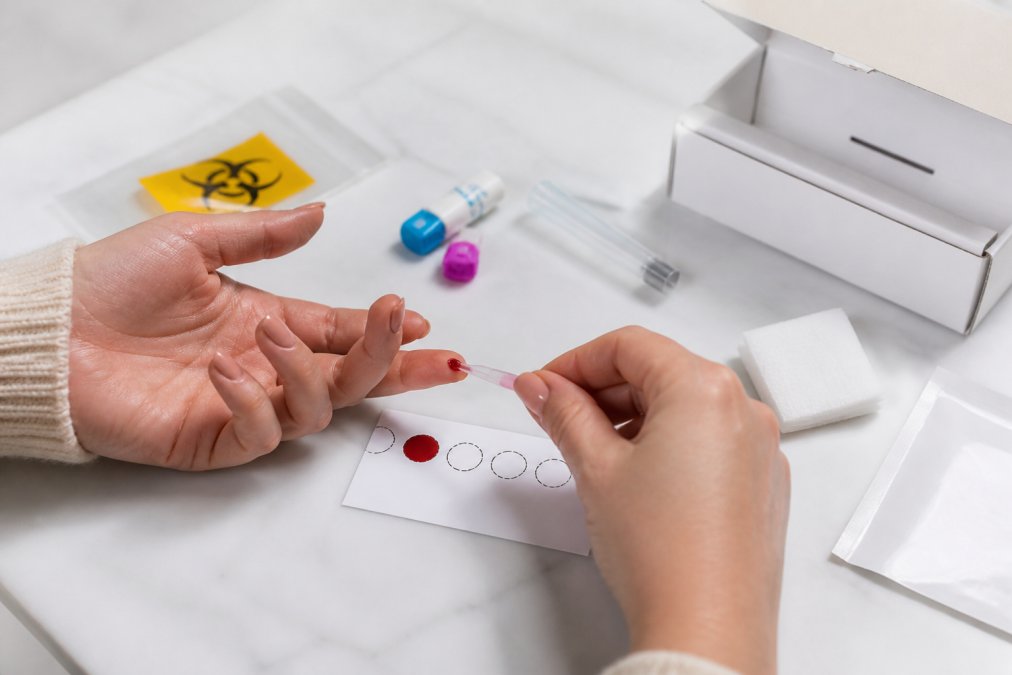
Fingerprick blood sampling (capillary blood collection) is the foundation of tests like Bien-Etre's NAD⁺ Intracellular Test. You receive a kit with lancets, collection cards, and instructions. Prick the side of your fingertip, allow several drops onto a specialised dried blood spot (DBS) card, seal, and return via prepaid post. The dried blood spot method is well-established in clinical pathology; NHS newborn screening programmes have used DBS cards for decades (the NHS).
Saliva collection, used in tests like Bien-Etre's DNA Skin Test, is simpler. Provide a saliva sample using a collection tube, seal it, and return it with prepaid postage. The stabilising solution preserves DNA and biomarkers during transport.
Clinical grade providers prevent pre-analytical error (contamination, improper storage, degradation) through:
- Clear, step-by-step instructions with video guides
- Prepaid, tracked return postage with temperature-stable packaging
- Barcoding and chain-of-custody documentation
- Standardised collection timing (some tests require fasting or specific times)
Self-sampling, when done correctly, produces results equivalent to phlebotomy-collected samples. The NHS has validated at-home self-sampling for several conditions; the key is following instructions precisely.
Accuracy, Validation and Laboratory Accreditation
Accuracy is defined by sensitivity (correctly identifying people with a condition) and specificity (correctly identifying people without it). Clinical grade providers publish these figures; consumer-grade providers typically don't.
Accreditation is the foundation of trust. CLIA (Clinical Laboratory Improvement Amendments) and ISO 15189 are the most widely recognised standards (the CDC). When a provider states their lab is accredited, they commit to regular audits, quality control protocols, and proficiency testing, external checks ensuring results match other accredited labs.
Bien-Etre's NAD⁺ test uses CLIA-accredited laboratory analysis, meaning the lab undergoes regular inspections, maintains documented quality standards, and participates in proficiency testing. This level of scrutiny is absent in most consumer DNA ancestry tests.
Clinical validation is separate from accreditation. NAD⁺ (nicotinamide adenine dinucleotide) measurement has growing research linking intracellular levels to cellular energy production, mitochondrial function, and age-related decline. Clinical grade NAD⁺ testing measures this biomarker using validated biochemical assays.
DNA-based tests like Bien-Etre's DNA Skin Test and DNA Nutrition Test rely on validated genetic associations. The DNA Skin Test analyses 13 clinically validated genes across five biological pathways (Firmness & Elasticity, Glycation, Sun Damage & Pigmentation, Free Radical Damage, Sensitivity & Inflammation) (peer-reviewed research). These genes have peer-reviewed evidence linking them to skin ageing outcomes, different from consumer DNA tests reporting ancestry or entertainment traits.
A clinical grade provider cites research behind their test, explains which genes or biomarkers they measure and why, and provides results you can discuss with a healthcare provider.
Private Blood Tests in the UK: What Sets Clinical Grade Apart
Private blood tests in the UK vary widely in quality and purpose. Some are convenience-driven; others are specialist tests unavailable on the NHS. Clinical grade private blood tests differ from routine convenience testing in diagnostic intent and analytical rigour.
The NHS provides comprehensive blood testing for diagnosed conditions and routine screening. Private testing fills gaps: biomarkers not routinely measured, preventative screening in asymptomatic people, and optimisation tests (like NAD⁺ levels for cellular health strategies). A clinical grade private blood test uses the same analytical methods as NHS pathology but may measure biomarkers the NHS doesn't routinely order.
What sets clinical grade apart is reporting. A routine private test gives a result with a reference range; a clinical grade report explains what it means: how your level compares to age-matched populations, what research suggests about your status, and what practical steps might support that biomarker.
Bien-Etre's clinical grade health testing emphasises plain-language interpretation. Rather than leaving you to decode medical jargon, reports explain findings in context, crucial because many people receive private results without knowing what to do with them.
Data Privacy and Confidentiality Standards
Genetic data and health biomarkers are sensitive personal information. UK data protection law, particularly the Data Protection Act 2018 and UK GDPR, governs how health data can be stored, processed, and shared. Clinical grade providers must be transparent about data handling.
When you order a clinical grade health testing kit, your data flows through collection, transport, laboratory analysis, reporting, and storage. Each stage carries privacy implications.
Your identity is linked to your sample via barcode. Reputable providers use tracked, sealed postage. The laboratory analyses your sample and generates a report. Your genetic data and biomarker results are stored on a secure online portal or provided as a downloadable PDF. telehealth infrastructure.
Critical questions: Does the provider sell or share your data? Do they retain your genetic information after reporting, and for how long? Are backups encrypted? Is access logged?
Clinical grade providers should publish a privacy policy answering these questions clearly. Bien-Etre treats genetic and biomarker data as confidential; reports are accessed through a secure portal with transparent data retention policies. Some providers retain anonymised data for research; this should be opt-in, not default.
If concerned about privacy, ask directly: Where is data stored? Who has access? How long is it retained? Can you request deletion? A provider answering clearly is more trustworthy than one deflecting.
How to Interpret Private Health Test Results
Receiving a private health test result can feel overwhelming. Interpreting results requires understanding three concepts: reference ranges, clinical significance, and actionability.
A reference range is the range of values observed in a healthy population. If your NAD⁺ result is 450 µM and the reference range is 400-600, you're within normal range. But "normal" doesn't mean optimal. A clinical grade report explains this: you might be within range but lower than expected for your age, or lower than the range associated with optimal cellular energy.
Clinical significance asks: Does this result matter? A result can be statistically different without being clinically meaningful. A clinical grade report flags results warranting attention and explains why. A NAD⁺ level at the lower end might suggest cellular energy production could be optimised through targeted supplementation or lifestyle changes.
Actionability is most important: What do I do with this information? A clinical grade report connects results to practical steps. If your NAD⁺ is low, the report might recommend dietary sources of NAD⁺ precursors, exercise protocols supporting NAD⁺ synthesis, or supplementation strategies, in plain language so you can discuss it with your doctor or health coach.

Common mistakes when interpreting results:
Treating one result as definitive. A single test captures a snapshot in time. Biomarkers fluctuate based on sleep, stress, diet, and exercise. Retesting 8-12 weeks later establishes trends rather than relying on one data point.
Ignoring context. Your age, sex, activity level, and health history influence what "normal" means for you. A NAD⁺ level average for a 50-year-old may concern a 40-year-old athlete. A clinical grade report contextualises your result within relevant populations.
Assuming results replace medical advice. A private health test provides data, not diagnosis. Discuss results with your GP or specialist. A clinical grade report explicitly states: "These results are for educational purposes and should be discussed with your healthcare provider."
CQC Registered Health Testing Providers and What That Means
The Care Quality Commission (CQC) is the independent regulator of health and social care in England. CQC registration doesn't apply to all at-home testing providers; it applies to organisations providing a regulated activity. For most direct-to-consumer at-home testing kits, CQC registration isn't required because the provider delivers a test, not care.
If a provider offers interpretation services, health coaching, or clinical guidance alongside testing, they may fall under CQC regulation. A CQC-registered provider has undergone inspection against five key lines: safety, effectiveness, responsiveness, caring, and leadership. CQC registration is a quality signal, but its absence doesn't mean a provider is untrustworthy, they may simply not meet the regulatory threshold.
What matters more for at-home testing is laboratory accreditation (CLIA, ISO 15189) and transparent privacy and data handling practices. Bien-Etre's clinical grade health testing relies on accredited laboratory partners and clear data governance, the foundations of trustworthiness regardless of CQC status.
When choosing providers, check: Is the laboratory accredited? Is the test validated in peer-reviewed research? Does the provider publish their privacy policy? Do they offer plain-language reporting? These factors matter more than regulatory status alone.
When to Follow Up With Your Doctor
A private health test result is a data point, not a diagnosis. When to follow up depends on your result, symptoms, and health history.
Follow up with your doctor if:
- Your result falls significantly outside the reference range
- You have symptoms correlating with your result (fatigue with low NAD⁺)
- Your result suggests a pattern over multiple tests
- You're considering supplementation or lifestyle changes and want professional guidance
- The report explicitly recommends clinical follow-up
Many GPs now discuss private testing results. Bring your report; a clinical grade report with plain-language explanations is easier for your doctor to interpret than raw lab printouts. If your GP isn't familiar with the test, ask for a referral to a relevant specialist.
Private health testing supports more informed conversations with your healthcare provider rather than replacing your GP. A clinical grade test makes that conversation easier because results invite discussion rather than confusion.
Clinical grade health testing at home represents a shift toward preventative, personalised health monitoring without clinic friction. Tests that matter are backed by accredited laboratories, validated science, and plain-language reporting designed for real-world action.
If you're ready to establish your baseline and understand your unique biology, Bien-Etre's clinical grade health testing kits provide that foundation. The NAD⁺ Intracellular Test (£299) measures your cellular energy status with CLIA-accredited analysis and a report designed for discussion with your healthcare provider. For comprehensive cellular optimisation, the Starter Pack, NAD⁺ Test + 1 Month of NAD+ (£299) includes your baseline test and a month of supplementation at no extra cost. Athletes and fitness enthusiasts may find the DNA Nutrition Test (£199) more relevant, analysing genetic factors influencing nutrient metabolism and food response. Get started with Bien-Etre and move from guessing to knowing.

Frequently Asked Questions
Q: What makes clinical grade health testing at home different from consumer DNA kits?
A: Clinical grade health testing uses accredited laboratory analysis, validated biomarkers, and diagnostic-level accuracy standards. Unlike consumer ancestry kits, clinical grade tests measure specific health markers (like NAD⁺ levels) with results suitable for clinical interpretation. The difference lies in analytical rigour, sample handling protocols, and whether results can inform health decisions alongside your doctor.
Q: Are private blood tests in the UK as accurate as NHS blood tests?
A: Yes, when performed by accredited laboratories. Private blood tests use the same analytical methods and quality standards as NHS testing when analysed by CLIA-accredited or ISO-certified facilities. The key difference is turnaround time and specific biomarkers tested. Private testing often offers faster results and specialised panels (like NAD⁺ or metabolic markers) not routinely available on the NHS.
Q: How do I know if a health testing provider is legitimate and trustworthy?
A: Look for laboratories with CLIA accreditation and ISO 15189 certification. Check whether the provider clearly states their laboratory partners, offers transparent privacy policies, and provides plain-language result interpretation. Legitimate providers disclose data handling practices and allow you to share results with your healthcare provider.
Q: What should I do after receiving my at-home test results?
A: Review your results carefully and discuss them with your doctor or healthcare provider, especially if results fall outside normal ranges. Most at-home tests provide educational insight, not medical diagnosis. Your doctor can advise whether follow-up testing is needed, whether lifestyle changes are appropriate, or if specialist consultation is warranted. Keep your results for future comparison and health tracking.
This article was written using GrandRanker