
Sports Recovery Beyond the Clinic: Your Options
Table of Contents
- Why Athletes and Non-Athletes Are Looking Beyond Traditional Clinics
- Sports Therapy for Non-Athletes: Recovery Without Competition Pressure
- At-Home Sports Recovery: Methods You Can Use Today
- Understanding Sports Injury Recovery Time and What Affects It
- Sports Recovery Tools: What Works and What Doesn't
- When to See a Professional and Red Flags Not to Ignore
- Using Data to Personalise Your Recovery Plan
- Frequently Asked Questions
Last Updated: October 9, 2026
Why Athletes and Non-Athletes Are Looking Beyond Traditional Clinics
Sports recovery alternatives are increasingly popular: people want flexibility, control, and personalised approaches without waiting for appointments or paying clinic fees.
Traditional clinics don't suit everyone: some live far from specialists, others prefer recovering at home, and many want to understand their own biology first.
At Bien-Etre, we recognise that effective recovery starts with data. That's why we've built at-home diagnostic testing that gives you measurable insights without the clinic visit.
This guide covers the main sports recovery alternatives available today: what works, what doesn't, and when you genuinely need a professional.
Sports Therapy for Non-Athletes: Recovery Without Competition Pressure
Sports therapy for non-athletes focuses on restoring movement and managing pain without the performance demands athletes face.
Non-athletes often experience the same injuries as athletes, a desk worker's shoulder tightness, a gardener's strained back, a parent lifting their child wrong.
Athletes need to return to competition; non-athletes need to return to daily life. This changes the recovery timeline and methods used.
Sports therapy for non-athletes typically addresses:
- Muscle strains and tightness from daily activities
- Overuse injuries from repetitive movements
- Postural problems from work or lifestyle habits
- Mobility loss from age or inactivity
Understanding your baseline helps recovery. Bien-Etre's lab-backed testing gives you that baseline, with clear, jargon-free reports showing where you stand.
At-Home Sports Recovery: Methods You Can Use Today
At-home sports recovery puts control in your hands: you choose when to recover, what method to use, and how long to spend.
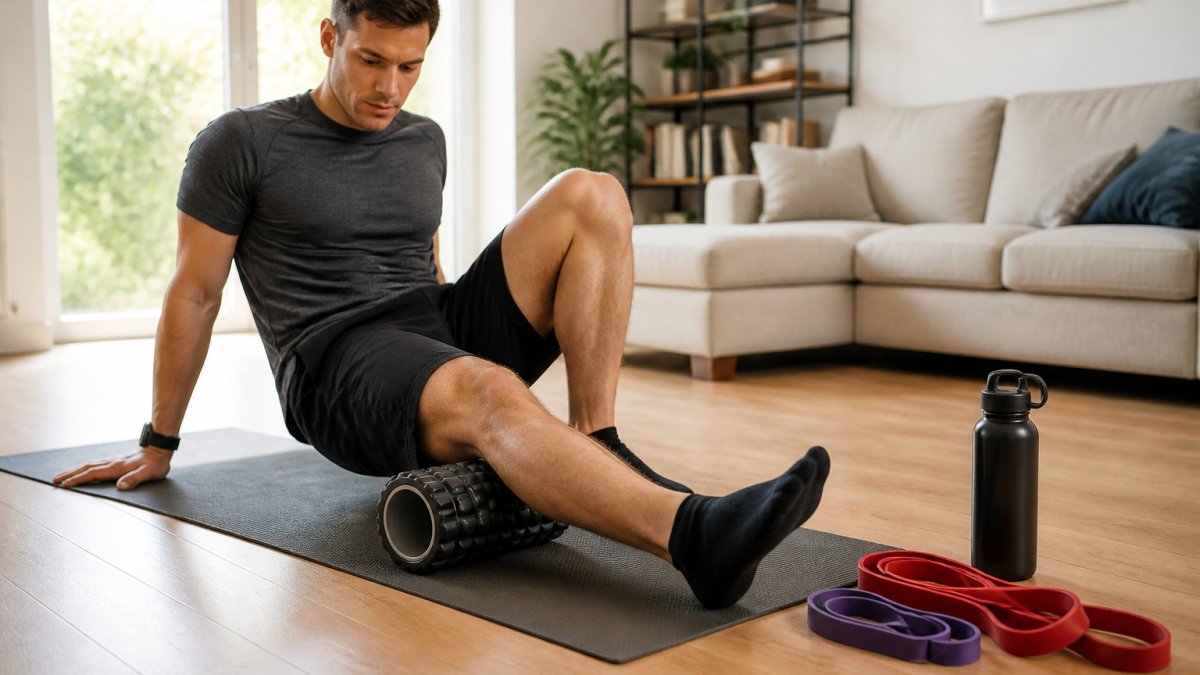
Foam Rolling and Myofascial Release
Foam rolling applies sustained pressure to soft tissue; pressure and friction reduce neural tone and improve local blood flow, temporarily reducing tightness. Evidence is moderate for short-term range-of-motion and soreness improvements, and weak for long-term injury risk.
How to do it properly:
- Roll slowly, roughly 2-3 cm per second, over the target area
- Pause on tender spots for 20-30 seconds rather than rolling back and forth
- Keep breathing; tensing up defeats the purpose
- Avoid rolling directly over the spine, bony prominences, or an acutely swollen joint
What to expect:
- Duration: 5-10 minutes per muscle group
- Frequency: 3-5 times per week
- Best for: Muscle tightness, recovery after training
- Cost: Foam rollers start at £15-30; a massage ball costs £8-15
Cold and Heat Therapy
Cold and heat are the cheapest tools you own, with strong evidence for specific uses, but they are not interchangeable.
Cold therapy constricts blood vessels, reduces local inflammation, and slows nerve conduction, which numbs pain.
Heat therapy dilates blood vessels and relaxes muscle tone. Use it for chronic stiffness, pre-exercise warm-up, and general muscle tightness.
How to use them:
- Cold: Ice pack or frozen peas wrapped in a damp cloth for 10-15 minutes, up to several times daily. Never apply ice directly to skin.
- Heat: Heat pad or warm shower for 15-20 minutes, once or twice daily
- Contrast therapy: Alternate 1 minute cold, 3 minutes heat, repeated 3-5 times, best used after training, not on a fresh injury
Cost is minimal. An ice pack costs £5-10. A heat pad costs £20-40. A reusable gel pack costs £8-15.
Stretching and Mobility Work
Stretching and mobility work restore range of motion, but they are not the same thing. Stretching lengthens a muscle under tension, hold a static stretch 20-30 seconds, repeat 2-4 times. Mobility work improves how a joint moves through its full range, combining stretching with strengthening and controlled movement.
Effective approaches:
- Static stretching: Hold stretches after training (10-15 minutes)
- Dynamic stretching: Moving stretches before training (5-10 minutes)
- Yoga: Combines stretching, strength, and mobility (20-60 minutes, 2-3 times weekly)
- Pilates: Focuses on core strength and movement control (30-45 minutes, 2-3 times weekly)
Evidence is strongest for regular movement and progressive loading rather than passive stretching alone: people who move well and load tissues gradually tend to have fewer injuries and recover faster.
Remote and Guided At-Home Options
For professional input without a clinic visit, several routes exist:
- Telehealth physiotherapy: Video appointments with a chartered physiotherapist, typically £30-70 per session. Useful for assessment, exercise prescription, and progress reviews.
- App-based rehab programmes: Subscription services that deliver structured exercise plans, usually £8-20 per month.
- Group classes: Yoga, Pilates, and mobility classes at local leisure centres or online, typically £8-15 per class or £30-60 per month for unlimited access.
- Self-directed programmes: Free NHS-backed resources and reputable charity guidance for common complaints.
When At-Home Recovery Is Not Enough
At-home methods suit minor strains, general tightness, and post-training recovery, but are not a substitute for assessment when:
- Pain is severe, worsening, or wakes you at night
- You cannot bear weight or move a joint through its normal range
- Swelling or bruising is significant or increasing
- You have numbness, tingling, or weakness
In those cases, seek assessment from a GP, a chartered physiotherapist, or an NHS urgent care service. Early assessment often shortens recovery rather than lengthening it.
Understanding Sports Injury Recovery Time and What Affects It
Recovery time depends on several factors. There's no universal answer.
What changes recovery time:
- Injury type: Muscle strains heal faster than tendon injuries
- Injury severity: Minor strains take days. Serious tears take weeks or months
- Age: Younger people typically recover faster
- Overall fitness: Fit people often recover faster
A minor muscle strain might heal in 1-2 weeks. A moderate strain takes 3-6 weeks.
The mistake most people make is guessing their recovery needs: resting too long (losing fitness) or returning too soon (re-injuring themselves).
This is where data helps. Bien-Etre's NAD⁺ testing shows your cellular energy capacity, which directly affects how fast you recover.
Sports Recovery Tools: What Works and What Doesn't
Many tools claim to speed recovery, but not all deliver. The table below grades the evidence and adds the practical detail most guides skip: who should avoid each tool, and what it costs in the UK.
| Tool | What It Does | Evidence | Best For | Typical UK Cost | Who Should Avoid It |
|---|---|---|---|---|---|
| Ice/heat | Reduces inflammation or relaxes muscles | Strong | Acute or chronic pain | £5-40 | Cold: circulation problems, Raynaud's. Heat: acute swelling, numb skin |
| Stretching and mobility | Improves flexibility and range of motion | Strong | Injury prevention, general function | Free | Acute muscle tear, unstable joint |
| Foam roller | Reduces short-term muscle tightness | Moderate | Daily recovery | £15-50 | Acute injury, bruising, swollen joints |
| Compression gear | Reduces swelling and supports muscles | Moderate | Post-training, travel | £30-100 | Peripheral arterial disease, severe varicose veins |
| Yoga and Pilates | Combines stretching, strength, and movement | Strong | Flexibility, mobility, core control | Free to £15/class | Acute injury, uncontrolled back pain |
| Acupuncture | Traditional approach to pain modulation | Moderate | Persistent pain management | £30-80 per session | Anticoagulant use, bleeding disorders, pregnancy (certain points) |
| Massage gun | Applies rapid percussive pressure | Limited | Muscle tightness | £50-300 | Acute injury, nerve pain, over bony areas |
| Cryotherapy | Whole-body cold exposure | Limited | Some high-level athletes | £50-100 per session | Cardiovascular conditions, cold intolerance, pregnancy |
| Laser treatment | Uses light to reduce inflammation | Mixed | Chronic pain | £50-150 per session | Photosensitivity, active cancer in the area |
How to Choose a Tool by Goal
Rather than buying the most expensive option, match the tool to what you are trying to achieve:
- Reduce acute pain and swelling: Cold therapy, elevation, compression
- Loosen chronic tightness: Heat, foam rolling, massage
- Improve flexibility and movement quality: Stretching, yoga, Pilates
- Support recovery after hard training: Compression, sleep, nutrition, light movement
Evidence Quality and What It Means
"Strong evidence" means multiple good-quality studies agree and the effect is consistent. "Moderate" means the effect is likely real but smaller or less consistent. "Limited" or "mixed" means evidence is weak, conflicting, or based on small studies, the tool may help some people, but don't rely on it.
The tools with the strongest evidence are the simplest and cheapest: ice, heat, movement, and sleep. Expensive tools tend to have weaker evidence and produce temporary relief rather than lasting change.
Costs, Access, and Time Commitment
- Free: Stretching, mobility work, sleep, hydration, walking
- Under £50: Ice packs, heat pads, foam rollers, resistance bands
- £50-300: Compression gear, massage guns
- Per session: Acupuncture (£30-80), cryotherapy (£50-100), laser (£50-150)
Some private health insurance policies cover physiotherapy and acupuncture when referred by a GP. NHS provision varies by area and waiting times can be long for non-urgent musculoskeletal care.
The Bottom Line
What matters is consistency and progression: someone who moves daily, sleeps well, and follows a structured plan recovers better than someone using an expensive tool once a week. Use tools to support a plan, not replace one.
When to See a Professional and Red Flags Not to Ignore
Some situations require professional help. Knowing when matters.
See a professional if:
- Pain is severe or worsening
- You can't move a joint normally
- Swelling doesn't improve after 48 hours
- Pain lasts longer than expected for that injury type
- You're unsure what's injured
Red flags that need urgent attention:
- Severe pain that came on suddenly
- Inability to bear weight on a leg
- Numbness or tingling that spreads
- Severe swelling that appears quickly
- Visible deformity
A professional can diagnose accurately, rule out serious damage, and create a structured recovery plan. Not every injury needs one, but ignoring warning signs is dangerous, when in doubt, get it checked.
Using Data to Personalise Your Recovery Plan
Generic recovery advice fails because you're not generic. Your body has unique needs.
Personalisation starts with measurement. You need to know:
- Your energy capacity (NAD⁺ levels tell you this)
Once you have data, build a recovery plan around it.
Example: If your NAD⁺ levels are low, your cells lack energy for repair. Rest becomes more important than intense training.
A personalised recovery plan includes:
- Rest days: Based on your actual recovery capacity
- Training intensity: Matched to your energy levels
- Nutrition timing: Aligned with your muscle repair needs
- Sleep targets: Adjusted for your recovery demands
- Tool selection: Chosen for your specific injury and body type
The result: faster, more effective recovery. You stop guessing. You start measuring.
Recovery doesn't have to mean months in a clinic.
Frequently Asked Questions
Can you recover from a sports injury without going to a clinic?
Yes, many injuries respond well to at-home care, especially in early stages. Rest, ice, compression, and elevation (RICE) work for acute strains and minor sprains. Foam rolling, stretching, and gentle strengthening exercises support recovery. However, severe pain, swelling that doesn't reduce, or loss of function warrant professional assessment. A healthcare provider can rule out serious damage and guide your at-home plan safely.
What are the benefits of sports therapy for non-athletes?
Sports therapy isn't just for competitive athletes. Non-athletes benefit from injury prevention, improved mobility, and faster recovery from everyday activities. Whether you're managing desk posture strain, recovering from a weekend gardening injury, or improving flexibility after 50, sports therapy addresses movement patterns and muscle tightness that affect daily function. It's tailored to your goals, not athletic performance.
How long does a typical sports injury take to recover?
Recovery time varies widely depending on injury type, severity, age, and how well you follow your rehabilitation plan. Minor muscle strains may heal in 2-4 weeks; ligament sprains can take 6-12 weeks or longer. Overuse injuries often require 4-8 weeks of modified activity. Factors like sleep quality, nutrition, and consistent rehabilitation significantly affect pace. Professional assessment helps set realistic timelines for your specific injury.
What should I look for in a sports recovery tool or method?
Choose tools based on your injury type, recovery stage, and evidence of effectiveness. Foam rollers suit muscle tightness and overuse; ice packs address acute inflammation; resistance bands support strength rebuilding. Consider cost, learning curve, and whether you'll actually use it consistently. Start with basic tools, many effective recovery methods are inexpensive. If results plateau after 3-4 weeks of consistent use, that's a signal to seek professional guidance.