
At-Home NAD+ Test: Clinical Accuracy Explained
Table of Contents
- What Is an At-Home NAD+ Test?
- How Clinical Accuracy Works in NAD+ Testing
- Signs and Symptoms of Low NAD+
- How the At-Home Testing Process Works
- How to Interpret NAD+ Test Results
- Factors That Affect NAD+ Test Accuracy
- Why Measure NAD+ Levels and What to Do Next
- Frequently Asked Questions
Last Updated: September 3, 2026
What Is an At-Home NAD+ Test?
An at-home NAD+ test is a clinical-grade diagnostic that measures intracellular nicotinamide adenine dinucleotide levels from a simple fingerprick blood sample collected at home. NAD+ is a critical coenzyme that fuels cellular energy production, DNA repair, and metabolic processes throughout your body. Unlike generic wellness tests, clinical-grade NAD+ testing provides quantifiable data about your cellular energy status, information that directly informs whether supplementation or lifestyle changes might help restore vitality.
The difference between a true clinical NAD+ test and trendy biohacking claims is significant. A validated assay measures actual intracellular NAD+ concentration using laboratory-grade analysis. This matters because cellular energy decline is measurable, not theoretical. When you receive results showing your NAD+ level, you're looking at a biomarker that correlates with how efficiently your mitochondria are functioning, the organelles responsible for generating the energy your body runs on.
At Bien-Etre, we've designed our NAD+ Intracellular Test to eliminate the friction of clinic visits while maintaining the rigour of clinical validation. You collect a dried blood spot at home using a simple fingerprick, post it to our accredited laboratory, and receive a detailed report. The test measures intracellular NAD+ concentration in blood plasma, giving you a snapshot of your cellular energy status. This baseline becomes your reference point for understanding whether interventions, supplementation, sleep optimisation, exercise patterns, are actually moving the needle.

How Clinical Accuracy Works in NAD+ Testing
Clinical accuracy in NAD+ testing depends on three interconnected factors: laboratory certification, sample collection reproducibility, and assay standardisation. Understanding how these work together explains why some at-home tests deliver clinically meaningful data while others produce numbers that don't reliably reflect your actual NAD+ status.
CLIA Certification and Laboratory Standards
A CLIA-certified laboratory (Clinical Laboratory Improvement Amendments in the United States context, or equivalent accreditation standards internationally) meets rigorous quality standards for sample analysis, staff qualifications, and quality control procedures. In the UK, the equivalent accreditation is UKAS (United Kingdom Accreditation Service), which verifies that laboratories maintain consistent analytical standards.
CLIA or UKAS certification doesn't guarantee accuracy, it guarantees process consistency. A certified lab must demonstrate that its equipment is calibrated regularly, that quality control samples are run alongside patient samples, and that results are reproducible. When you receive NAD+ results from a certified facility, you're getting measurements conducted under standardised conditions with documented chain of custody.
The practical implication: if your NAD+ test comes from a non-certified laboratory, the number you receive may be internally consistent but not comparable to other tests or to reference ranges established in clinical studies. You're paying for a number, not a clinically meaningful measurement. Bien-Etre partners exclusively with CLIA-accredited and UKAS-accredited laboratories to ensure your results meet clinical standards and can be meaningfully discussed with your healthcare provider or performance coach.
Dried Blood Spot Collection and Reproducibility
A dried blood spot (DBS) is a fingerprick sample applied to a specialised collection card, allowed to dry, and posted to the laboratory. This method has advantages and limitations for NAD+ testing.
The advantage is convenience, you don't need a venous blood draw or a clinic visit. The limitation is that dried blood spot samples introduce variables that affect reproducibility. How much blood you apply, how quickly it dries, how it's stored during transit, and the exact spot selected for analysis all influence the final measurement. These variables are manageable but real.
Reproducibility, the ability to get the same result if you test twice in the same week under identical conditions, is a key measure of test accuracy. A test with poor reproducibility might show your NAD+ as 850 µM one week and 720 µM the next, even though nothing in your biology changed. That's measurement noise, not biological change.
The coefficient of variation (CV) is how laboratories quantify reproducibility. A CV below 10% is considered acceptable for most biomarkers; below 5% is excellent (peer-reviewed research). When evaluating an at-home NAD+ test, ask what the assay's CV is. If the provider can't answer, that's a red flag. At Bien-Etre, our assay maintains a CV well within clinical standards, meaning your results are reproducible and your follow-up tests are genuinely comparable.
Signs and Symptoms of Low NAD+
Low NAD+ typically manifests as persistent fatigue that doesn't improve with sleep, difficulty recovering from exercise, brain fog or cognitive sluggishness, and reduced physical endurance. However, these symptoms overlap with dozens of other conditions, thyroid dysfunction, sleep apnoea, depression, anaemia, and chronic stress all produce similar presentations.
This is why testing matters. Symptoms alone can't tell you whether your NAD+ is genuinely depleted or whether another mechanism is at play. A clinical NAD+ test gives you objective data to either confirm or rule out NAD+ depletion as a contributing factor.
Some athletes and fitness enthusiasts notice that their recovery times have slowed or that they're not bouncing back from training sessions the way they used to. Women in perimenopause or menopause often experience fatigue that feels different from ordinary tiredness, a cellular exhaustion that persists despite adequate sleep. Busy professionals frequently report that they're hitting an energy wall by mid-afternoon, struggling to maintain focus through meetings, and feeling depleted by evening.
None of these observations diagnoses low NAD+. But they're reasonable signals to measure your baseline, establish whether NAD+ depletion is actually occurring, and then decide whether supplementation or lifestyle adjustments are worth pursuing.
How the At-Home Testing Process Works
The at-home NAD+ testing process is straightforward: you receive a collection kit, perform a simple fingerprick at home, apply blood to a collection card, and post the sample to our accredited laboratory.
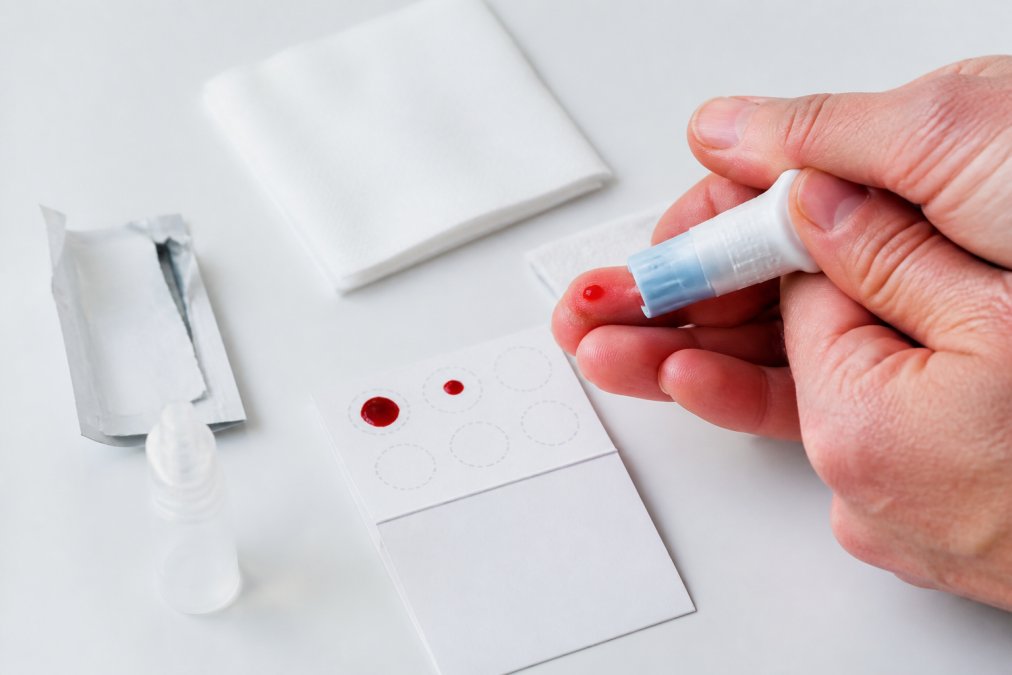
Here's the step-by-step workflow:
-
Order and receive your kit, You'll get a collection card, sterile lancet, collection tube, and detailed instructions.
-
Prepare your fingerprick, Wash your hands with warm water and soap. Choose a finger (typically the side of your ring finger or middle finger works best). Allow the area to air-dry completely.
-
Perform the fingerprick, Using the sterile lancet provided, prick the side of your fingertip firmly enough to produce a small drop of blood. The lancet is designed to minimise pain and create a consistent puncture depth.
-
Apply blood to the collection card, Gently squeeze your finger to produce a drop of blood and apply it to the designated spot on the collection card. You'll typically need 3-5 small spots. Allow each spot to dry completely (usually 2-3 minutes per spot).
-
Complete and seal the card, Once all spots are dry, complete the information section on the card, place it in the provided envelope, and seal it.
-
Post the sample, Use the prepaid Royal Mail envelope to post your sample.
-
Receive your results, Within 10-14 working days of the laboratory receiving your sample, you'll receive a detailed report via secure online portal. Your results include your NAD+ concentration, how it compares to reference ranges, and contextual information about what your levels suggest about cellular energy status.
How to Interpret NAD+ Test Results
Your NAD+ test report will show a single primary measurement: your intracellular NAD+ concentration, typically expressed in micromolar (µM) units. Understanding what that number means requires context.
Understanding Your Reference Range and Optimal Levels
A reference range is the distribution of NAD+ levels observed in a healthy population. If the reference range is 500-1,200 µM, that means most healthy adults fall somewhere in that band. Your result will show where you sit within that range.
But "within the reference range" doesn't mean optimal. A reference range reflects what's typical, not what's ideal. You could have an NAD+ level of 520 µM (technically within range) while still experiencing fatigue because your individual biology thrives at higher levels. Conversely, you might measure 1,100 µM and feel energetic because that's sufficient for your particular metabolic demands. lab-based hormone testing.
This is why the report context matters. A good NAD+ test report doesn't just give you a number, it explains what that number means for your cellular energy production, how it compares to age-matched peers, and whether it aligns with the symptoms you're experiencing.
What Your Results Tell You About Cellular Energy and Aging
NAD+ directly fuels your cells' energy-producing machinery. It's a critical cofactor in mitochondrial respiration, the process that converts glucose and fat into usable energy (ATP) (peer-reviewed research). When NAD+ levels decline, mitochondrial efficiency drops, and you feel it as fatigue, slower recovery, and reduced endurance.
NAD+ also regulates cellular aging processes. Sirtuins are a family of proteins that depend on NAD+ to function. These proteins control DNA repair, mitochondrial health, and cellular stress responses (peer-reviewed research). When NAD+ is abundant, sirtuins are active and your cells maintain better repair and maintenance. When NAD+ drops, sirtuin activity declines and cellular aging accelerates.
Your NAD+ result is a window into both your present energy status and your cellular aging trajectory. A low result doesn't mean you're doomed to decline, it means you have a measurable target to address. A healthy result suggests your cellular energy machinery is functioning well relative to your age and activity level.
Factors That Affect NAD+ Test Accuracy
Several practical factors can influence your NAD+ measurement, and understanding them helps you interpret your results with appropriate confidence.
Fasting status, NAD+ levels fluctuate slightly depending on recent food intake and metabolic state. For consistency, most labs recommend testing in a fasted state (8-12 hours without food). If you eat a large meal and then test immediately, your NAD+ may read slightly lower than your true baseline because your body is actively using NAD+ in metabolic processing.
Time of day, Circadian rhythms influence NAD+ availability. NAD+ tends to be slightly higher in the morning and lower in the evening, reflecting your body's energy demands throughout the day. Testing at the same time of day across multiple tests improves comparability.
Recent exercise, Intense exercise depletes NAD+ acutely as your muscles burn through energy. If you test within 24 hours of strenuous activity, your NAD+ may read lower than your typical baseline. Wait at least 24 hours after hard training before collecting a sample if you're trying to establish your true resting NAD+ level.
Stress and sleep deprivation, Chronic stress and poor sleep both suppress NAD+ levels. If you're sleep-deprived or under acute stress when you test, your result may underestimate your typical NAD+ capacity.
Supplementation timing, If you're already taking NAD+ precursors (NMN, NR, or other compounds), your measured level reflects your supplemented state, not your baseline. If you want to know your natural NAD+ level, test before starting supplementation. If you're already supplementing and want to measure the effect, that's a valid test too, just be clear about what you're measuring.
Sample handling, Dried blood spot samples are stable at room temperature, but extreme heat or moisture during transit can degrade them. Ensure your sample dries completely before posting and use the provided mailer to protect it during transit.
These factors don't invalidate your test, they just explain normal biological variation. The key is consistency: test under similar conditions each time so your follow-up measurements are genuinely comparable.
Why Measure NAD+ Levels and What to Do Next
Measuring your NAD+ level answers a specific question: is cellular energy depletion a factor in how you're feeling? If your result is low, you have a clear target. If your result is healthy, you can rule out NAD+ deficiency and focus on other causes of fatigue.
Once you have your baseline, the next steps depend on your result and your goals.
If your NAD+ is low: Supplementation with NAD+ precursors (NMN or NR) or lifestyle interventions (increased exercise, better sleep, reduced stress) can raise NAD+ levels. The Bien-Etre Starter Pack combines your baseline test with a month of NAD+ supplementation, giving you the data and the tools to start optimising.
If your NAD+ is healthy: You might still benefit from monitoring it over time as you age. NAD+ naturally declines with age, so establishing a baseline now gives you a reference point to track whether your interventions (exercise, sleep, supplementation) are slowing that decline.
Discuss your results with your healthcare provider or performance coach. Your NAD+ report is designed to be jargon-free and actionable. Bring it to your next appointment and use it as a starting point for a conversation about whether supplementation makes sense for your situation, whether other metabolic factors need investigation, or whether lifestyle adjustments alone might be sufficient.
The real value of at-home NAD+ testing isn't the test itself, it's the data-driven conversation it enables. Instead of guessing why you feel run down or whether a supplement might help, you have objective information to guide your decisions.
Persistent fatigue and declining energy are frustrating, but they're not inevitable. With Bien-Etre's clinical-grade NAD+ Intracellular Test, you can measure your cellular energy status and understand exactly what's driving how you feel. Our test delivers results you can trust, analysed by CLIA-accredited laboratories using validated assays, in a clear, jargon-free report designed for you and your healthcare provider to act on. Stop guessing about your energy levels. Get started with Bien-Etre and establish your NAD+ baseline today.
Frequently Asked Questions
How accurate are at-home NAD+ tests compared to clinical blood tests?
At-home NAD+ tests using dried blood spots analysed by CLIA-certified laboratories achieve clinical-grade accuracy when collection and handling protocols are followed correctly. The dried blood spot method concentrates metabolites, often providing reliable measurement of intracellular NAD+ levels. Accuracy depends on proper sample collection, storage, and laboratory validation. Reputable providers use established assays with documented reproducibility and coefficient of variation data. Your results are comparable to those from a clinical setting when collected through an accredited service.
What factors can affect the accuracy of my at-home NAD+ test results?
Several factors influence accuracy: fasting state (ideally test after 10-12 hours without food), time of day (circadian rhythms affect NAD+ levels), recent intense exercise, sleep quality, stress levels, and medications. Proper sample collection is critical, ensure your fingertip is clean and the blood spots are completely saturated on the collection card. Storage and shipping conditions matter; samples must reach the laboratory promptly to prevent degradation. Following your provider's pre-test instructions carefully maximises result reliability.
How do I interpret my NAD+ test results?
Your report will show your intracellular NAD+ concentration against a reference range established from healthy populations. Higher levels typically indicate better mitochondrial function and cellular energy production. Lower levels may correlate with fatigue, reduced recovery, or metabolic stress. However, a single result is a snapshot; context matters. Consider your age, fitness level, sleep, stress, and diet when evaluating results. A qualified healthcare provider can help you interpret findings in relation to your specific symptoms and health goals.
Can I use at-home NAD+ test results to guide supplementation decisions?
Your baseline NAD+ level provides valuable data for personalised supplementation strategies. If your results show low levels, NAD+ precursors like nicotinamide riboside (NR) or nicotinamide mononucleotide (NMN) may help raise intracellular NAD+. However, supplementation response varies by individual based on genetics, diet, and lifestyle. Many people benefit from retesting after 4-8 weeks of consistent supplementation to measure changes. Always discuss results and supplementation plans with your healthcare provider to ensure they align with your overall health strategy.
This article was written using GrandRanker