
VitaminaLab Alternative for Personalized Health
Table of Contents
- What to Look for in a VitaminaLab Alternative
- How At-Home Health Testing Works
- Building a Personalized Supplement Routine Based on DNA
- Benefits of DNA-Based Nutrition for Energy and Recovery
- How to Interpret At-Home Health Diagnostic Reports
- Comparing Personalized Health Tests: Features, Pricing and Privacy
- Data Privacy and Security of Your Health Metrics
- Conclusion
- Frequently Asked Questions
Last Updated: September 22, 2026
What to Look for in a VitaminaLab Alternative
If you are searching for a VitaminaLab alternative for personalized health, the priority is a service that turns your own biological data into a plan you can follow. Bien-Etre pairs clinical-grade NAD⁺ testing with DNA-based nutrition reports and jargon-free guidance. This guide explains how to compare at-home testing services on the criteria that matter: lab accreditation, markers tested, how results are explained, and how your data is protected.
- Clinical-grade analysis. Your sample should be processed by an accredited laboratory using validated protocols, not a wellness gadget.
- Plain-language reports. A result you cannot interpret is not a result. It is noise.
- A clear next step. The report should tell you what to discuss with your GP, coach or nutritionist.
How At-Home Health Testing Works
At-home health testing means collecting a sample yourself, posting it to a laboratory, and receiving a digital report without visiting a clinic. Most services use a fingerprick blood spot or cheek swab.
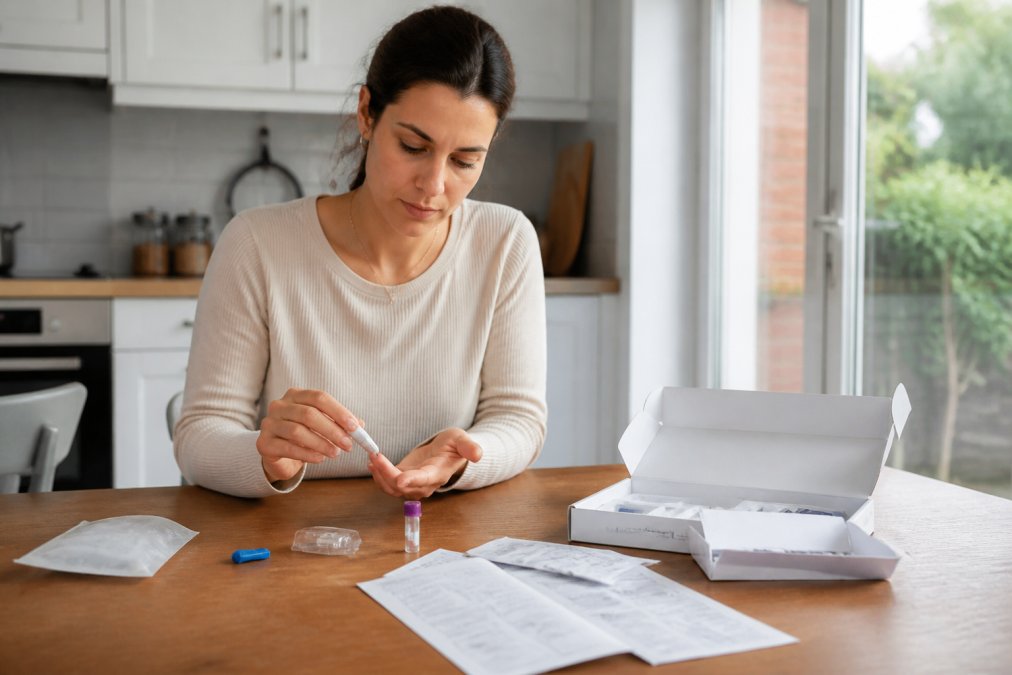
The process follows a consistent pattern:
- Order your kit, which arrives with instructions and prepaid return packaging.
- Collect your sample at home, usually in a few minutes.
- Post it to the laboratory for analysis.
- Receive a secure digital report explaining your results.
Building a Personalized Supplement Routine Based on DNA
A personalized supplement routine based on DNA starts with your genes, not a shelf of bottles. Genetic testing can show how your body may process nutrients such as folate, B12, vitamin D, magnesium and omega-3s, a sensible starting point rather than a guess.
A workable routine looks like this:
- Test first to establish what your body actually needs.
- Address the gaps your report flags, in priority order.
- Retest after roughly 90 days to see whether your changes worked.
Benefits of DNA-Based Nutrition for Energy and Recovery
Generic wellness advice offers plenty of recommendations and no evidence any apply to you. Genetic and biomarker data replace that guesswork with something you can track.
How to Interpret At-Home Health Diagnostic Reports
Interpreting at-home health diagnostic reports is simpler than most people expect, provided the report is written for humans. A good report states what was measured, what the result means, and what to do next.
- What was measured. Confirm the marker and the units used.
- Where you sit. Look for your result against the reference range.
- What it means. Read the plain-language explanation, not just the number.
- What to do. Note any suggested next steps to raise with your provider.
Comparing Personalized Health Tests: Features, Pricing and Privacy
Comparing personalized health tests means weighing four things: what is measured, who analyses it, how results are explained, and cost over time. Most guides stop at the sticker price, the wrong number, because the value of a personalized health service is only visible when you can compare a result before and after an intervention.
Bien-Etre's range covers the main entry points:
| Option | Price | What You Get | Best For |
|---|---|---|---|
| NAD⁺ Intracellular Test | £299.00 | At-home fingerprick, CLIA-accredited lab, report in 7-10 working days | Establishing a baseline |
| Starter Pack (NAD⁺ Test + 1 Month NAD+) | £299.00 | Test plus one month of NAD+ supplement included | Testing and starting together |
| 60 Day Cellular Recharge (NAD⁺ Test + 60 Days NMN300) | £199.00 | Test plus two months of NMN300, free UK delivery | A longer measured trial |
| DNA Nutrition Test | £199.00 | Genetic nutrition and fitness report, PDF to share | Building a nutrition plan |
The cost-benefit question most guides avoid
A single test is a snapshot; a bundle with a supplement and retest window is a before-and-after experiment. They are not the same product and should not be judged on price alone.

Subscription versus one-off: what you are really paying for
Subscription models usually bundle three things: the test, the supplement, and ongoing access to your data. The subscription is worth it when you intend to retest, and poor value when you do not, because you pay a recurring fee for a supplement you could buy separately.
What actually drives the price
Three cost drivers explain almost all price differences between providers:
Starter Pack — NAD⁺ Test + 1 Month of →
- Laboratory accreditation and assay type. A validated intracellular NAD⁺ assay run in an accredited laboratory costs more to deliver than a spot-check wellness reading. The accreditation is the reason you can take the result to a clinician.
- Marker breadth. A panel covering nutrient metabolism, food sensitivities, metabolic health and recovery factors involves more analysis than a single-marker test, and the report has to explain each finding.
- Report quality and support. A PDF that states a number is cheap to produce. A report that explains what the number means and what to raise with your GP or nutritionist is not.
Privacy as a pricing factor
Data handling is not free and should not be invisible. A provider that stores genetic and biomarker data in a secure portal, allows download and deletion, and does not share with third parties carries a cost a data-harvesting competitor does not. When one service looks unusually cheap, ask what is being monetised instead. The NAD⁺ Intracellular Test and the DNA Nutrition Test are both delivered as secure digital reports with PDF download, so you control who sees the result.

A simple way to compare
Before you buy, write down four numbers: upfront cost, retest cost, the cost of the supplement you would buy anyway, and how long you intend to stay on the protocol. Add them up across twelve months. The cheapest-looking option is rarely cheapest once the retest is included, and the most expensive-looking bundle is often better value because it already contains the step that tells you whether anything changed.
Data Privacy and Security of Your Health Metrics
Data privacy is the factor most comparison guides skip, and the one you should check first. Genetic and biomarker data is sensitive in a way a step count is not: it cannot be changed like a password, and once a genetic profile is shared it is shared permanently, potentially revealing information about relatives who never consented.
The framework to apply before you send a sample
Work through these in order. If a provider cannot answer any one of them plainly, treat that as your answer.
- Who analyses the sample. The laboratory should be accredited and named. The laboratory should be accredited and named. A provider that will not name its laboratory is asking you to trust a black box.
- Where the data is stored. Ask whether results are held on servers in the UK or European Economic Area, and whether the provider is registered with the Information Commissioner's Office (ICO) as a data controller.
- What the lawful basis is. Under the UK GDPR and the Data Protection Act 2018, health and genetic data is classified as special category data (What is special category data?). That means the provider needs a specific lawful basis to process it, and consent must be explicit and informed, not buried in terms and conditions.
- Your rights in practice. You have the right to access your data, to have it corrected, to have it erased, and to receive it in a portable format. Ask how you would exercise those rights and how long a request takes. A provider that makes deletion difficult is telling you something.
- Third-party sharing. Ask directly whether data is shared with insurers, employers, research partners, or advertising networks. Genetic data shared with an insurer is a materially different risk from data shared with a laboratory information system.
- Retention period. How long is your sample kept, and how long is your data kept? A defined retention schedule is a sign of a mature data practice. "Indefinitely" is not an answer.
What good looks like in practice
Bien-Etre delivers results as a secure digital report with a PDF download, so you decide who sees the result. The NAD⁺ Intracellular Test is analysed by a CLIA-accredited laboratory, and the DNA Nutrition Test by accredited partner laboratories using validated genetic protocols. Because the output is a document you hold, you can share it with your GP, coach or nutritionist on your own terms, and you are not dependent on continued portal access to keep your results.
The questions worth asking in writing
Before you order, email the provider four questions: which accredited laboratory processes the sample; whether the organisation is ICO-registered; how you request deletion of your data; and whether data is ever shared with third parties. A mature privacy practice answers quickly and specifically; deflection to a generic privacy policy previews how your data will be handled after the sale.
Conclusion
Sorting through testing services is difficult, and the marketing rarely helps. Judge each option on accreditation, clarity and data handling rather than the promise on the box.
Frequently Asked Questions
Are personalized vitamin subscriptions worth the investment?
It depends on whether you have data to guide them. A personalized health plan built on DNA or biomarker results can direct spending toward nutrients your body actually needs, rather than a generic multivitamin. Bundles that combine a test with a supplement, such as the Starter Pack at £299, let you establish a baseline before committing to a longer routine. One-off tests start at £199, so you can try a single product before subscribing.
How do DNA-based supplement routines differ from standard multivitamins?
Standard multivitamins use fixed doses designed for an average adult. A personalized supplement routine based on DNA looks at how your genes influence nutrient processing, including folate, B12, vitamin D, magnesium and omega-3s. That means the report may flag areas where food or supplement guidance is relevant to you, instead of covering every nutrient at the same level. It is educational insight, not a diagnosis, so review findings with your GP or nutritionist before changing anything.
What should I look for in a personalized health diagnostic provider?
Check three things: who analyses your sample, how results are explained, and what happens to your data. Look for accredited laboratory analysis, plain-language reports you can share with your doctor, and a clear privacy policy covering genetic and biomarker data. Also check whether the provider offers a retest pathway, since measuring progress over 60 to 90 days is the only way to know whether a supplement protocol is working.
Are there UK-based alternatives for personalized nutritional support?
Yes. Several providers now offer at-home testing with UK shipping and laboratory analysis. Bien-Etre dispatches its 60 Day Cellular Recharge bundle from a UK facility with free tracked delivery, and its DNA Nutrition Test is analysed by accredited partner laboratories. When comparing options, check where the sample is processed, whether the report is written in plain English, and whether you can download a PDF to share with your GP or coach.