
Can Lab Tests Confirm Perimenopause? A Practical Guide
Table of Contents
- Why Lab Tests Cannot Confirm Perimenopause
- Symptoms of Perimenopause: What Your GP Actually Looks For
- Understanding Hormone Fluctuations and Why They Complicate Testing
- When Blood Tests Are Actually Necessary
- NICE Guidelines for Menopause Diagnosis: What the Evidence Shows
- When to See a GP for Perimenopause: Building Your Case
- Using a Symptom Diary to Support Your Diagnosis
- Conclusion: Lab Tests as Part of Your Bigger Picture
Last Updated: August 16, 2026
Why Lab Tests Cannot Confirm Perimenopause
Lab tests alone cannot confirm perimenopause. Perimenopause is a clinical diagnosis based on symptoms and menstrual history, not hormone levels. During the perimenopausal transition, hormone fluctuations are so erratic and individual that a single blood test snapshot cannot reliably capture what's happening across weeks or months.
Many women arrive at their GP's surgery with lab results expecting confirmation, only to learn that normal-range hormone readings don't rule out perimenopause, and abnormal readings don't necessarily confirm it. Oestradiol and progesterone levels can swing wildly from day to day. One day a test shows reproductive-range levels; the next week, levels have dropped significantly. This variability is the core problem with relying on any single hormone profile.
What GPs actually look for is clinical presentation: your symptoms and menstrual cycle pattern. The NICE guidelines for menopause diagnosis emphasise symptom-based assessment, not biochemical markers, because evidence shows this approach is more reliable for identifying perimenopause.
Symptoms of Perimenopause: What Your GP Actually Looks For
Your GP will ask about specific symptoms because these matter for diagnosis. Hot flushes and night sweats are the most recognisable vasomotor symptoms, but perimenopause presents differently for different women. Some experience severe hot flushes; others have subtle temperature fluctuations.

Irregular periods are often the first sign. You might skip a month, then have a heavier-than-normal period, then return to a relatively normal cycle. Sleep disturbance, whether from night sweats or waking without obvious reason, affects many women. Fatigue that doesn't improve with rest is common. Brain fog, difficulty concentrating, and memory lapses are documented symptoms.
GPs will also ask about mood changes, joint or muscle aches, changes in skin or hair, and sexual function. Mood symptoms can range from mild irritability to significant depression or anxiety. Some women experience new-onset migraines or worsening of existing ones. Vaginal dryness and urinary symptoms occur because oestrogen receptors are present throughout the urogenital tract.
Your GP is building a symptom profile, not waiting for a lab result. When you describe a pattern of irregular periods plus hot flushes plus sleep disruption, that clinical picture points toward perimenopause far more reliably than any hormone level. Keeping a detailed record of what you're experiencing becomes your strongest diagnostic tool.
Understanding Hormone Fluctuations and Why They Complicate Testing
Hormonal fluctuations during perimenopause are why lab tests create confusion rather than clarity. FSH (Follicle-Stimulating Hormone) rises as ovarian function declines, but it doesn't rise in a straight line. It spikes and dips unpredictably. Oestradiol follows a chaotic pattern, sometimes elevated, sometimes low, sometimes within normal range for reproductive-age women. Progesterone becomes erratic because ovulation becomes irregular.
A blood test captures hormone levels at one moment in time. If you're tested on a day when FSH happens to be low, the result might look "normal." If tested during an FSH spike, it might look like menopause. Neither tells you what's actually happening across the month or year. This is the fundamental limitation of hormone testing for perimenopause diagnosis.
Some cycles include ovulation; others don't. When ovulation occurs, progesterone production follows. When it doesn't, progesterone stays low. Testing on day 3 versus day 21 of your cycle can yield completely different results. Testing in one month versus another might show entirely different patterns.
This is why the NICE guidelines for menopause diagnosis don't recommend routine hormone testing for women over 45 with typical symptoms. The test results don't change management, and they often create false reassurance or unnecessary anxiety. A normal FSH doesn't mean you're not in perimenopause. An elevated FSH doesn't confirm perimenopause on its own. Clinical judgment based on your symptom pattern is more reliable.
When Blood Tests Are Actually Necessary
Blood tests do have a place in perimenopause assessment, but it's narrower than many women expect. Testing is useful when your presentation is atypical or when other conditions need to be ruled out. If you're experiencing symptoms that could be thyroid-related, fatigue, mood changes, weight changes, temperature sensitivity, thyroid function testing (TSH and free T4) becomes important. Thyroid dysfunction can mimic or overlap with perimenopause symptoms.
If you have significant mood symptoms, testing for vitamin B12 and folate deficiency is reasonable. Iron studies may be relevant if you have heavy periods and fatigue. A full blood count can identify anaemia, which is common when periods become heavier.
Testing is also warranted if your symptoms began unusually early (before age 40), which might suggest premature ovarian insufficiency (POI). In this case, FSH and oestradiol testing, ideally repeated on two separate occasions a few weeks apart, can help establish whether you're dealing with POI rather than typical perimenopause.
If you're considering hormone replacement therapy (HRT), some clinicians may order baseline testing to document your pre-treatment hormone status. Bone density screening (DEXA scan) may be recommended depending on your age, risk factors, and family history.
Testing should be targeted and purposeful, not routine. If your symptoms fit the perimenopause picture and other conditions have been reasonably excluded, additional hormone testing usually adds little value.
NICE Guidelines for Menopause Diagnosis: What the Evidence Shows
The NICE guidelines for menopause diagnosis reflect the current evidence base and represent the standard approach in clinical practice. According to NICE guidance on menopause, diagnosis in women over 45 with typical menopausal symptoms is a clinical diagnosis based on symptoms and menstrual history. Routine hormone testing is not recommended for diagnosis.
For women aged 40-45, if symptoms are typical of menopause, diagnosis is still clinical. However, if there's diagnostic uncertainty or if symptoms are atypical, hormone testing may be considered. The NICE approach prioritises symptom assessment and clinical judgment over biochemical markers because evidence shows this is more reliable and cost-effective.
The guidelines acknowledge that hormone levels fluctuate significantly during perimenopause and that a single measurement is unlikely to be helpful for diagnosis. Testing is recommended only when there's specific clinical indication: ruling out other conditions, assessing bone health risk, or managing cases of premature ovarian insufficiency.
This evidence-based approach reflects research showing that symptom-based diagnosis is accurate and that routine hormone testing in women with clear perimenopause symptoms doesn't improve outcomes. Women diagnosed clinically based on symptoms respond well to appropriate management. The diagnosis doesn't need biochemical confirmation to be valid.
When to See a GP for Perimenopause: Building Your Case
Coming prepared with specific information about your symptoms and their pattern makes the conversation more productive. Many women report that initial concerns about perimenopause were dismissed or attributed to stress, partly because they weren't able to describe the symptom pattern clearly.
The best preparation is a symptom diary. Track your period dates, flow, any spotting between periods, and any pattern you notice. Record when hot flushes occur and roughly how many per day. Note sleep quality and any night sweats. Write down mood changes, not just low mood, but irritability, anxiety, or emotional sensitivity. Include any other symptoms: brain fog, joint aches, headaches, or changes in energy levels. Keep this for at least one to two months before your appointment.
Bring this record to your GP. It provides concrete evidence of the symptom pattern, which is far more persuasive than describing symptoms from memory. Be specific about how symptoms are affecting you. "I'm waking three or four times a week drenched in sweat and sleeping only 4-5 hours total" is more useful than "I'm having trouble sleeping." Symptom severity and functional impact matter in clinical assessment.
Ask your GP directly about perimenopause if you think that's what you're experiencing. If your GP dismisses your concerns without exploring perimenopause, ask specifically whether they've considered it and why. If you're not satisfied with the response, consider seeing a menopause specialist.
Using a Symptom Diary to Support Your Diagnosis
A symptom diary is your strongest diagnostic tool, more valuable than any lab test. It shifts the conversation from subjective impression to documented pattern, which is exactly what your GP needs to see.
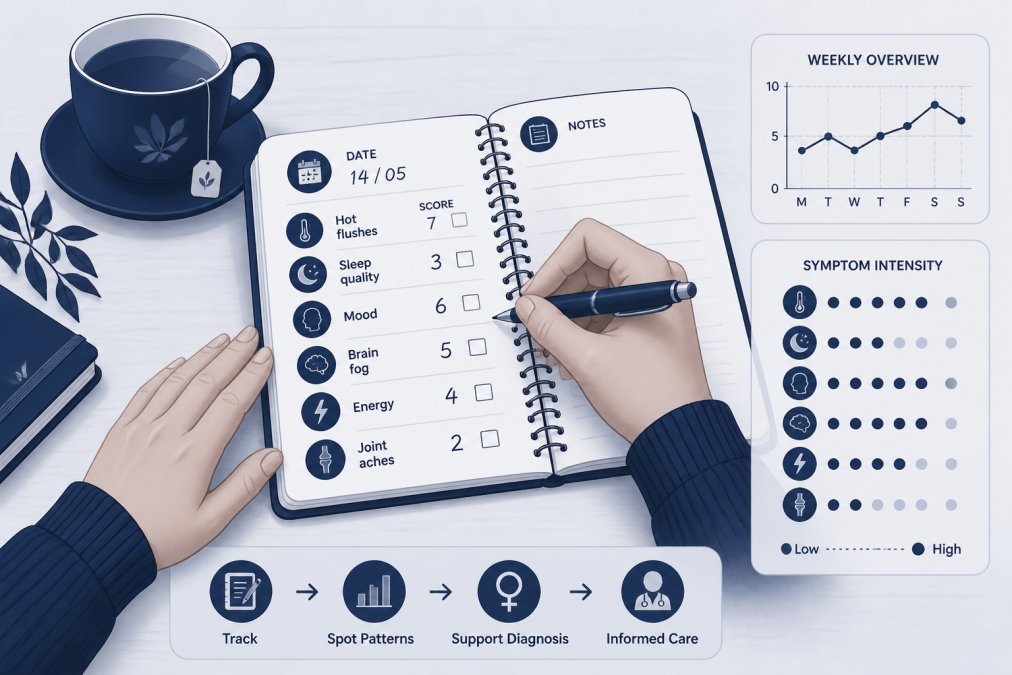
What to track:
| Symptom | How to Record | Why It Matters |
|---|---|---|
| Menstrual cycle | Date period starts, duration, flow (light/moderate/heavy) | Shows irregularity pattern |
| Hot flushes | Time of day, duration, severity (mild/moderate/severe), frequency | Documents vasomotor symptoms |
| Night sweats | How many times you wake, whether bed/clothes are wet | Distinguishes from other causes of poor sleep |
| Sleep quality | Time to fall asleep, number of awakenings, total hours | Shows sleep disruption pattern |
| Mood | Any irritability, anxiety, low mood, emotional sensitivity | Documents mood changes |
| Energy/fatigue | Energy level 1-10, any pattern (worse certain times of day/month) | Shows fatigue pattern |
| Brain fog | Days with difficulty concentrating or memory lapses | Documents cognitive symptoms |
| Other symptoms | Headaches, joint aches, vaginal dryness, anything unusual | Captures full symptom picture |
Keep the diary for at least 8-12 weeks. This timeframe is long enough to show patterns but short enough to remain manageable. You'll start seeing cycles and patterns related to your menstrual cycle or consistent timing of certain symptoms.
When you review your diary before your GP appointment, highlight the patterns you notice. Do hot flushes happen every day or sporadically? Does sleep disruption follow a pattern? Does mood change at particular times? These patterns are what your GP is looking for.
Bring the diary to your appointment and share it directly. Having the written record is powerful. It demonstrates that your symptoms are real, measurable, and affecting your daily life. It also shows you're engaged in your own healthcare, which often prompts a more thorough clinical response.
If you're considering Bien-Etre's at-home diagnostic testing, a symptom diary complements that approach. While Bien-Etre provides lab-backed insights into your health markers like NAD⁺ levels and DNA-based skin analysis, a symptom diary documents your clinical experience. Together, they create a comprehensive picture to discuss with your GP.
Conclusion: Lab Tests as Part of Your Bigger Picture
Lab tests have a supporting role in perimenopause assessment, not the lead. Blood tests can rule out other conditions that mimic perimenopause symptoms. They can identify specific deficiencies or dysfunction that needs treatment. They can establish baseline health markers before starting HRT. But they cannot confirm perimenopause on their own.
The clinical diagnosis of perimenopause is built on your symptoms, your menstrual history, and your healthcare provider's assessment. This approach is supported by evidence and reflected in NICE guidelines because it works. Women diagnosed clinically respond well to appropriate management.
If you're experiencing symptoms you suspect are perimenopause, start with a symptom diary. Document the pattern of your symptoms over 8-12 weeks. Then schedule a conversation with your GP, bringing your documented evidence. If you want additional insight into your overall health markers, Bien-Etre's at-home diagnostic testing provides lab-backed data on NAD⁺ levels and DNA-based health insights, information that complements your clinical assessment. The combination of documented symptoms, clinical assessment, and personalised health data creates the strongest foundation for understanding what's happening in your body and making informed decisions about your care.
Frequently Asked Questions
Can a GP do a blood test for perimenopause?
Yes, your GP can order blood tests, but they are not used to confirm perimenopause as a diagnosis. Blood tests may be useful to rule out other conditions that cause similar symptoms, such as thyroid disorders or premature ovarian insufficiency. Hormone levels like FSH and oestradiol fluctuate significantly during perimenopause, making single test results unreliable for diagnosis. Your GP will typically diagnose perimenopause based on your symptoms and medical history rather than test results alone.
Why does NICE guidance advise against routine blood tests for perimenopause?
NICE guidelines recommend against routine hormone testing for perimenopause diagnosis because hormone levels fluctuate unpredictably throughout the menstrual cycle and during the transition itself. A single blood test may show normal FSH levels one week and elevated levels the next, leading to false reassurance or unnecessary alarm. Clinical diagnosis based on your reported symptoms, such as irregular periods, hot flushes, and night sweats, is more reliable and cost-effective than repeated testing. Blood tests are reserved for specific situations, such as confirming premature ovarian insufficiency or excluding other conditions.
How do doctors confirm perimenopause without blood tests?
Doctors diagnose perimenopause primarily through your symptom history and menstrual pattern. Key indicators include irregular periods, vasomotor symptoms like hot flushes and night sweats, mood changes, and sleep disruption. Your GP will ask about the timing and severity of symptoms, any family history of early menopause, and your age. This symptom-based assessment aligns with clinical guidelines and avoids the confusion caused by hormone fluctuations. If your symptoms are atypical or other conditions are suspected, your GP may recommend blood tests to investigate further.
What if my blood test results don't match my symptoms?
Mismatches between blood test results and symptoms are common during perimenopause due to hormonal fluctuations. A 'normal' FSH level does not rule out perimenopause if you have clear symptoms, and an elevated level does not confirm it. This is why symptom-based diagnosis is preferred. If you experience significant symptoms but your tests appear normal, discuss this with your GP, it may indicate you are still in early perimenopause, or other factors may be contributing. Keeping a detailed symptom diary helps your GP see the full picture beyond a single test result.
This article was written using GrandRanker