
What Is Data-Driven Wellness Explained for 2026
Table of Contents
- What Data-Driven Wellness Actually Means (and What It Isn't)
- How to Interpret Preventative Health Biomarkers Without a Medical Degree
- The Benefits of At-Home Diagnostic Testing for Busy Adults
- Understanding NAD+ Levels for Health Optimisation
- The Metrics That Matter: Wearables, Screening and Health Surveys
- Ethics, Data Privacy and the Limits of Workplace Health Monitoring
- Conclusion: Turning Numbers Into a Plan You Can Act On
- Frequently Asked Questions
Last Updated: September 27, 2026
What Data-Driven Wellness Actually Means (and What It Isn't)
Data-driven wellness is the practice of using measurable personal health data, rather than population averages or general advice, to guide decisions about nutrition, recovery, supplementation and preventative care. This guide from Bien-Etre explains what that means in practice and where it stops being useful.
The shift from population averages to personal baselines
According to NHS guidance on NHS Health Check, preventative checks are offered to adults in England aged 40 to 74, which reflects how much of long-term health risk is manageable when it is caught early rather than late.
How to Interpret Preventative Health Biomarkers Without a Medical Degree
Interpreting a biomarker means reading your result against two different scales: the reference range the laboratory uses, and the optimal range discussed in research literature. The first tells you whether a clinician would flag it. The second tells you whether it is worth a conversation.
Most people only ever see the first.
Reference ranges vs optimal ranges: what the numbers actually tell you
A reference range is calculated from the population the laboratory tested. It describes what is common, not what is ideal. Roughly 95% of that population falls inside it by definition, so a result can sit comfortably in range and still be far from where you function best.
Three practical rules for reading any report:
- Check the units before the number, because a different unit changes everything
- Look at the trend across tests, not one isolated result
- Write down one question per flagged marker for your GP or specialist
The Benefits of At-Home Diagnostic Testing for Busy Adults
At-home diagnostic testing lets you collect a sample yourself, usually a fingerprick dried blood spot or a cheek swab, and post it to an accredited laboratory for analysis. For anyone juggling work, training and family, it removes the appointment, the travel and the waiting room.
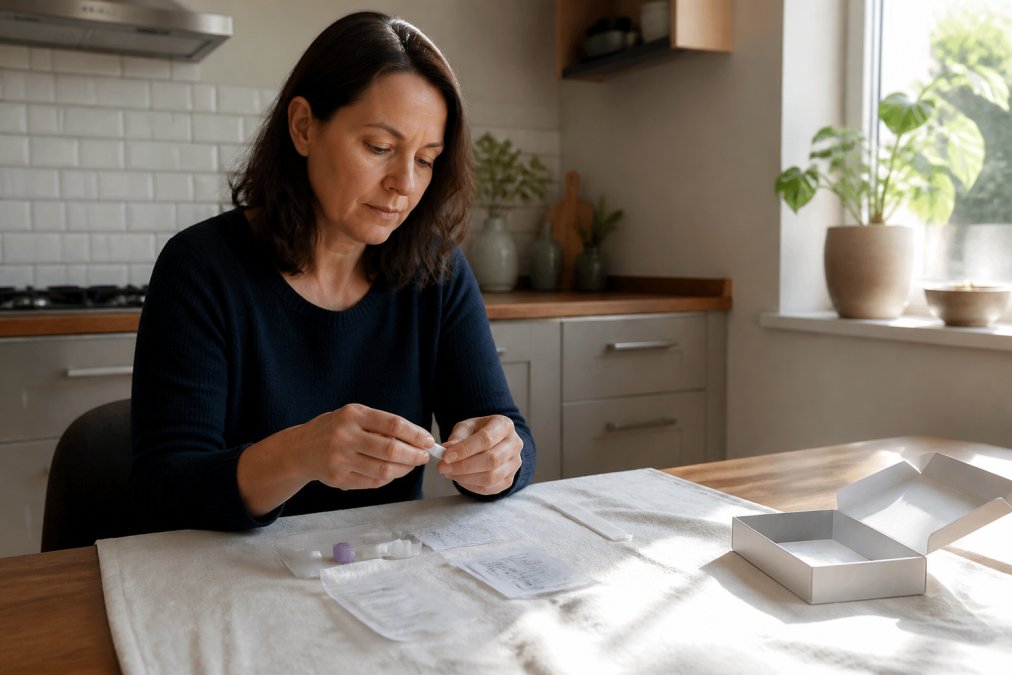
From fingerprick to report: what to expect from a sample kit
The process is deliberately short. You order the kit, collect the sample at home in a few minutes, return it in the prepaid packaging, and receive a digital report once the laboratory has run the analysis.
| Step | What happens | Typical timing |
|---|---|---|
| Order | Kit dispatched with instructions | 1-3 working days |
| Collect | Fingerprick or swab at home | A few minutes |
| Return | Prepaid packaging, standard post | Same week |
| Analyse | Accredited laboratory runs the panel | 7-10 working days |
| Act | Review report with your GP or coach | Within 2 weeks |
Understanding NAD+ Levels for Health Optimisation
Two caveats worth stating plainly. These tests provide educational insight and are not a medical diagnosis. Supplements are food supplements, not medicines, and anyone pregnant, nursing, taking medication or managing a condition should speak to their healthcare provider first.
The Metrics That Matter: Wearables, Screening and Health Surveys
No single metric tells the whole story, and the most expensive one is not automatically the most useful. A sensible dashboard combines what you wear, what you measure in a laboratory, and what you report about yourself, and it only becomes useful once you can read each layer.
What wearables actually measure (and what they don't)
Consumer wearables typically capture four things well:
- Sleep duration and timing, total sleep and when you slept, which is more reliable than sleep quality scores
- Resting heart rate, a slow drift upward over weeks often precedes illness or overtraining
- Heart rate variability (HRV), beat-to-beat variation, a rough proxy for recovery and autonomic load
- Daily movement, steps and active minutes, useful for trends rather than targets
What they do not do is diagnose. A wearable can tell you your HRV dropped for five consecutive days; it cannot tell you whether that is alcohol, a virus, poor sleep or stress. Treat the device as a smoke detector, not a fire investigator.
Laboratory biomarkers: the point-in-time layer
Biomarker testing gives you a laboratory figure for things a wrist sensor cannot see, nutrient status, metabolic markers, inflammatory signals, NAD⁺. The trade-off is that it is a snapshot, not a stream. One result tells you where you are; a repeat result tells you what changed. This is why retesting at a consistent interval matters more than testing often.
Health surveys: the layer no sensor reads
Validated questionnaires capture sleep quality, perceived stress, mood and fatigue, the subjective experience that wearable data misses. A common pattern is someone whose step count and resting heart rate look fine but whose stress and sleep-quality scores have been sliding for a month. Without the survey layer, that slide is invisible.
How to combine the three layers
The UK Health Security Agency publishes national data on population health that is useful context when you want to know how your numbers compare with the wider picture, though your own baseline always matters more.
Data literacy: the skill most programmes skip
Handing someone a dashboard they cannot interpret produces anxiety, not behaviour change. Before any tracking programme, personal or workplace, it is worth learning four basics: what a reference range is, what a trend line shows that a single reading does not, how to spot a metric that is noisy versus one that is stable, and when a number is worth raising with a GP.
Starter Pack — NAD⁺ Test + 1 Month of →
Where mental health data fits
Sleep, mood and stress markers are among the most sensitive things you can collect, and they are also the ones most likely to be mishandled. If you are tracking them, separate them from performance metrics entirely, review them on your own terms, and be cautious about any programme that wants to aggregate them for an employer.
Ethics, Data Privacy and the Limits of Workplace Health Monitoring
Workplace health monitoring sits in genuinely uncomfortable territory, and the honest answer is that it should be voluntary, transparent and clearly separated from performance management. The same wearable that helps an employee understand their sleep can, in the wrong hands, become a productivity scoreboard. Most content on this topic stops at the 'how-to' and the benefits.
The surveillance question
There is a real difference between wellness data and performance data, and the two should never share a pipeline. A step count collected to help someone move more is wellness data. The same step count reviewed in a promotion meeting is performance data. Once the second use exists, the first becomes untrustworthy, because people start managing the metric rather than their health.
Three limits worth holding to:
- Health data collected at work should never feed disciplinary or promotion decisions
- Employees should know exactly what is collected, who sees it and how long it is kept
- Genetic and biomarker data deserves stricter handling than step counts
What the law actually requires
Under UK GDPR and the Data Protection Act 2018, health information is special category personal data, which means it requires a lawful basis and additional safeguards. In practice that means a documented lawful basis (usually explicit consent), a data protection impact assessment for anything systematic, data minimisation, and a clear retention schedule.
The data literacy gap
Handing someone a dashboard they cannot interpret produces anxiety, not behaviour change. Employers get better results by funding a short explanation session than by buying another sensor. Teach people what a reference range is, what a trend line shows that a single reading does not, and when a number is worth raising with a GP.
The mental health data problem
Sleep, mood and stress markers are among the most sensitive things you can collect, and they are also the ones most likely to be mishandled. Psychological safety is a precondition for honest self-reporting: if people fear the data will be used against them, the survey layer stops being data at all.
A practical test before you opt in
Ask four questions: What is collected? Who can see it? What is it used for? When is it deleted? If any answer is vague, treat that as your answer. Voluntary, transparent and separated from performance is the only version of workplace health monitoring that earns the data it collects.
Conclusion: Turning Numbers Into a Plan You Can Act On
The gap between having data and benefiting from it is interpretation. A report full of numbers you cannot read changes nothing, and a supplement routine built on guesswork is expensive theatre.
Frequently Asked Questions
What is data-driven wellness in simple terms?
Data-driven wellness means using measurable information about your own body, such as blood markers, sleep patterns or genetic results, to decide what to eat, how to train and when to rest. Instead of following advice built for an average person, you track your own baseline and retest to see whether a change actually worked. A wearable step count, a biomarker report or a nutrition test all feed the same idea: measure first, then act.
How do biomarkers help in tracking personal health?
Biomarkers are objective measurements, such as vitamin D, folate, iron or NAD+ levels, that show what is happening inside your body at a point in time. Tracking them over months creates longitudinal data, which is far more useful than a single reading. A one-off result tells you where you stand; a series of results tells you whether your supplement routine, diet or training is moving that number in the right direction.
Is data-driven wellness regulated in the UK?
It depends on the component. At-home diagnostic kits that make health claims are regulated as medical devices by the Medicines and Healthcare products Regulatory Agency (MHRA), while any personal data you submit is covered by the UK GDPR and the Data Protection Act 2018. Food supplements fall under general food law rather than medicines regulation. Always check whether a provider uses an accredited laboratory and states clearly that its report is educational, not a diagnosis.
How is at-home testing different from asking my GP for more blood work?
NHS blood tests are ordered when there is a clinical reason, so they tend to cover a defined panel rather than the markers you might want for optimisation. At-home kits let you test specific things, such as NAD+ or genetic nutrient metabolism, on your own schedule and retest at intervals you choose. They are not a replacement for medical care. Use the report to start a more informed conversation with your GP or specialist.
What does an NAD+ test actually measure?
An intracellular NAD+ test measures the level of nicotinamide adenine dinucleotide inside your cells, using a dried blood spot sample collected at home. NAD+ is involved in energy metabolism and cellular repair, and levels tend to decline with age. Knowing your baseline gives you a reference point. If you then take a supplement such as nicotinamide riboside or nicotinamide mononucleotide, retesting after roughly 90 days shows whether your level has moved.
Where does my genetic or biomarker data go, and who can see it?
Under the UK GDPR you have the right to know what is collected, why, how long it is kept and who it is shared with. Reputable providers analyse samples in accredited laboratories and store results in a secure digital account you control. Before ordering, read the privacy notice and check whether you can request deletion. If a workplace programme is involved, ask specifically whether individual results are visible to your employer or only aggregated.
I'm training for a half-marathon. Will this kind of data help my recovery?
It can, if you test the markers that relate to recovery. A DNA nutrition test looks at genetic factors affecting inflammation, oxidative stress and sleep, which gives you context for how you fuel and rest. Pairing that with a baseline NAD+ reading lets you track whether a supplementation plan changes anything measurable. Combine the numbers with how you actually feel and perform, and review them with a coach or clinician rather than acting on a single result.