
At-Home Hormone Test UK Reviews 2026: What to Expect
Table of Contents
- What Is an At-Home Hormone Test and How Does It Work?
- Perimenopause Blood Test Accuracy: What the Evidence Shows
- How to Interpret Hormone Test Results Without the Jargon
- Private Hormone Testing vs NHS: Key Differences
- Privacy and Data Security: What Happens to Your Sample?
- Post-Test Action Plan: Using Results with Your Clinician
- Frequently Asked Questions
Last Updated: September 26, 2026
What Is an At-Home Hormone Test and How Does It Work?
An at-home hormone test is a diagnostic kit that lets you collect a sample yourself, post it to a laboratory, and receive a report on your hormone levels without visiting a clinic. This guide from Bien-Etre explains what the kits measure, where accuracy varies, and how to use the results.
The appeal is obvious: no waiting room, no appointment weeks out, no morning off work. For anyone tracking perimenopause symptoms or unexplained fatigue, that convenience matters.
But convenience and clinical usefulness are not the same thing. The test is only as good as the sample you collect, the lab that analyses it, and the clinician who reviews it.
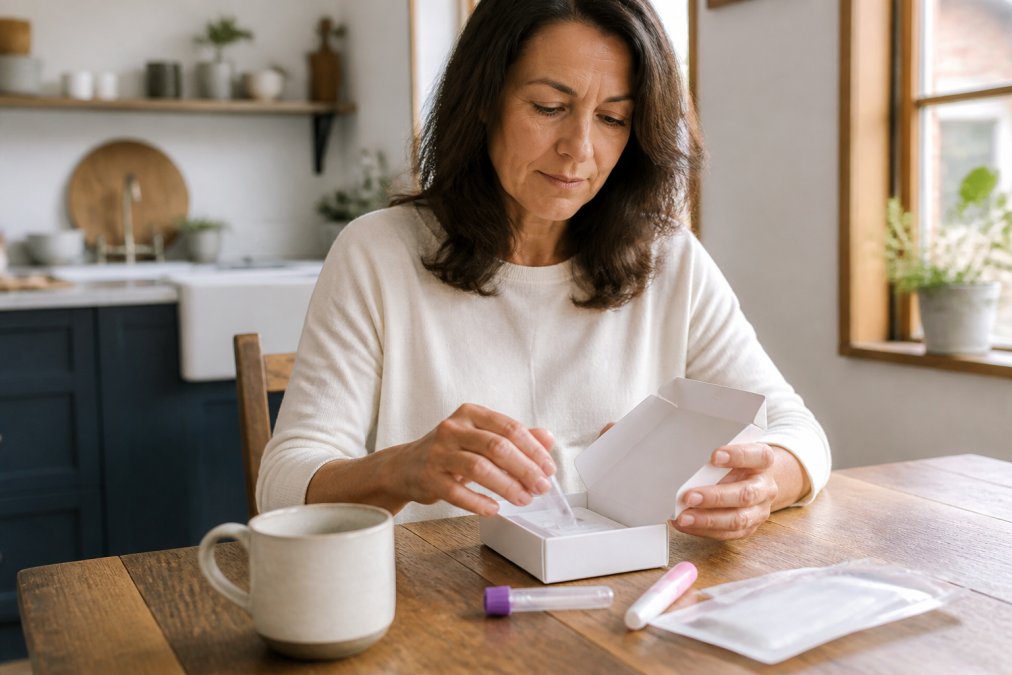
Collection Methods: Finger-Prick vs Venous Blood
Most kits use one of two collection methods, and the difference affects usability and reliability.
Finger-prick (capillary) collection involves pricking a fingertip with a small lancet and filling a tube or spotting card with blood.
| Method | Who Collects | Main Advantage | Main Limitation |
|---|---|---|---|
| Finger-prick | You, at home | Convenient, low cost | Technique-sensitive |
| Venous draw | Phlebotomist | Standard reference base | Needs an appointment |
| Saliva | You, at home | Easy repeat sampling | Not suitable for all markers |
Perimenopause Blood Test Accuracy: What the Evidence Shows
Perimenopause blood test accuracy depends heavily on timing, because hormone levels swing widely during the menopause transition. A single reading can look "normal" one week and abnormal the next, so one test rarely tells the whole story.
Cycle-Day Timing: The Rule Most Kits Do Not Tell You
If you are still having periods, the day you collect changes what the number means. A common clinical pattern is:
- Follicle-stimulating hormone (FSH), most informative in the early follicular phase, roughly days 2 to 5 of your cycle. During perimenopause, FSH often rises and fluctuates, so a single high reading is not diagnostic on its own.
- Oestrogen (oestradiol), also usually read in the early follicular phase, but levels can spike mid-cycle and drop in the luteal phase, so a random sample is easy to misread.
- Progesterone, only meaningful in the luteal phase, roughly days 21 to 23 of a 28-day cycle (or about seven days before your expected period). Testing it on day 5 tells you almost nothing.
- Testosterone, typically collected in the morning, as levels follow a daily rhythm.
- Cortisol, strongly time-dependent. A single morning sample is not the same as a 24-hour picture, and many kits ask for a specific collection window for this reason.
Collection Method Changes the Number
Two kits measuring the same hormone can return different values if they use different sample types, a scientific detail, not a marketing one.
- Venous blood is the sample type most laboratory reference ranges are built on, making results easier to compare with a GP-ordered test.
- Finger-prick (capillary) blood is convenient but more technique-sensitive: a cold hand, a hesitant prick, or a partially filled tube can shift a result.
- Saliva works for some hormones (notably cortisol, where it captures a daily curve) but is not interchangeable with blood for others, including most sex hormones bound to carrier proteins.
- Urine is used for some metabolite panels and daily patterns, but measures what has been cleared, not circulating levels.
What Accuracy Actually Means Here
"Accuracy" in at-home testing has three parts:
- Analytical accuracy, does the laboratory measure the hormone correctly? This is where UKAS-accredited laboratories matter.
- Pre-analytical accuracy, was the sample collected, stored, and posted correctly? This is largely on you, and it is where most home errors happen.
- Interpretive accuracy, is the result read against the right reference range for your age, sex, and cycle stage? This is where a clinician adds value a dashboard cannot.
For women already in the menopause transition, FSH tends to rise and oestrogen to fluctuate. Neither pattern is diagnostic on its own, and no home kit replaces a proper clinical assessment. A clinician can interpret your results alongside your symptoms and history.
How to Interpret Hormone Test Results Without the Jargon
Interpreting hormone test results means reading each value against the reference range for your age, sex, and cycle stage, then looking at the pattern across markers rather than any single number. Dense terminology is the main reason people give up on reports.
Understanding Reference Ranges and Cycle Timing
A reference range is the spread of values seen in a healthy comparison group. It is not a target or a diagnosis: falling inside does not guarantee everything is fine, and falling slightly outside does not automatically mean something is wrong.
Key markers you will typically see include:
- Oestrogen and progesterone, the main sex hormones, both cycle-dependent
- Testosterone, present in all bodies and relevant to energy and libido
- Cortisol, a stress hormone with a strong daily rhythm
- Thyroid function, which affects energy, weight, and mood
- Follicle-stimulating hormone and luteinizing hormone, which drive the cycle
What to Do With a Result That Is Out of Range
Most guides stop at the number. If a marker sits outside its reference range, work through three steps before you panic or ignore it.
Questions to Take to Your GP Appointment
A short, specific list gets you further than a printout. Ask:
- Does this result need repeating, and on which cycle day?
- Should any of these markers be checked on the NHS rather than privately?
- Could my symptoms be explained by something other than the hormone measured here?
- Is a referral appropriate, and to which service?
- Are there any medications or conditions that would make this result unreliable?
Lifestyle Levers That Actually Move the Markers
No at-home test changes a hormone. Behaviour does. The evidence-backed levers are unglamorous but consistent:
- Sleep, cortisol and thyroid markers are sensitive to poor or irregular sleep. A consistent sleep and wake time is one of the few interventions with a measurable effect.
- Alcohol and caffeine, both can shift cortisol patterns and sleep quality, indirectly shifting markers.
- Resistance training and protein intake, relevant to testosterone, insulin sensitivity, and body composition, all of which interact with sex hormones.
- Stress load, chronic stress affects cortisol rhythm and can suppress other hormones; a measurable axis, not a wellness cliché.
- Weight change, significant loss or gain alters sex hormone and thyroid readings, sometimes within weeks.
Private Hormone Testing vs NHS: Key Differences
Private hormone testing versus NHS testing comes down to speed, scope, and who interprets the result. NHS testing is free at the point of use and ordered when a clinician judges it necessary; private testing is paid for directly and usually available on demand.
Privacy and Data Security: What Happens to Your Sample?
Privacy is the question people ask last and worry about most. Your sample and your data are separate things, and both need protecting.
- Which laboratory processes your sample and where it is located
- How long your sample and data are retained
- Whether your data is used for research, and whether you can opt out
- How to request deletion of your records
Post-Test Action Plan: Using Results with Your Clinician
A result you do nothing with is wasted money. Turn it into a plan, starting with a conversation.
Frequently Asked Questions
Are at-home hormone tests as accurate as GP blood tests?
At-home hormone tests that use accredited laboratories and venous blood samples can be as accurate as GP tests for many biomarkers. Finger-prick capillary blood tests are convenient but may have slightly higher risk of pre-analytical error if the sample is not collected correctly. Always check that the kit uses a UKAS-accredited lab and provides clinician-reviewed results.
When is the best time in my cycle to take a hormone test?
For cycle-specific hormones like oestrogen, progesterone, follicle-stimulating hormone (FSH), and luteinizing hormone (LH), timing matters. Day 3 of your cycle is typical for baseline FSH and oestrogen. Progesterone is usually tested around day 21 of a 28-day cycle. If you are in perimenopause or menopause, your clinician may advise testing on any day. Always follow the kit instructions or ask your GP.
How do I interpret my hormone test results?
Your results will include reference ranges for each hormone, but these ranges vary by age, cycle phase, and laboratory. Look for clear, jargon-free explanations and a summary that highlights out-of-range values. Do not self-diagnose or adjust medication based on a single test. Share the report with your GP or a qualified clinician to discuss what the numbers mean for your symptoms and health.
What happens to my data after I send in a sample?
Reputable at-home testing companies should explain their data privacy policy before you buy. Look for GDPR compliance, clear retention periods, and whether your data is shared with third parties. Your sample should be anonymised before lab analysis where possible. You have the right to request deletion of your data. If privacy is a concern, contact the company directly with your questions.
Hormone testing at home gives you data, but data alone does not change how you feel. What changes things is pairing clear results with a proper conversation about your health.
Bien-Etre provides at-home diagnostic testing with accredited labs, jargon-free reports, and insights built around your biology rather than population averages. If you want measurable answers instead of guesswork, explore what Bien-Etre offers and bring your results to your next appointment with confidence.